CUPE-OCHU Labour History

CUPE was created on September 24, 1963

Public sector employees were among the last to form unions but, even then, there is a long deep history
to the efforts of those that went before us. The letter carriers in the Post Office formed a union in 1891.
Then, in 1907, workers employed in the federal government formed the “Civil Service Association,”
which, in 1966, became the “Public Service Alliance of Canada.”

OCHU has its own deep roots. The “National Union of Public Service Employees” (NUPSE) was an early
Canadian public-sector union. It traced it’s roots back to 1921 when the Canadian Electrical Trade Union
was formed in Toronto. Initially, its membership was centered in the Toronto area. As they organized
more members, it gradually expanded beyond municipal electrical workers and represented a wider
range of public service employees. It expanded from coast-to-coast and adopted the name NUPSE in
1952.

Hospital workers were forming unions as early as the 1930s. The “Trades and Labour Congress of
Canada” (TLC) would help those organizing by chartering hospital workers into independent “Federal
Unions.” In 1953, those locals were transferred to a new 12,000-member organization that was being
formed. After working with little contact or solidarity with activists in other hospital unions, this new
structure was a welcome advancement. In 1954, it became the “National Union of Public Employees”
(NUPE).

After several years of discussions in the late 1950s and the early 1960s, NUPSE and NUPE were ready to
unite. Both held conventions in Winnipeg on September 23, 1963, voting to merge. The following day,
they formed the “Canadian Union of Public Employees” (CUPE), becoming a major national union in
Canada and the largest public sector union.

Stanley Little, the first CUPE President, spoke about the task which confronted the new union. He told
members that their responsibility was to challenge all public employees to take their rightful place in the
community and share the responsibility by being an important part of Canadian labour. One of the
important areas of development he believed was in hospitals “because this is a group whose wages are
well below the rest of the community and who are badly in need of the strength and protection that a
union organization can bring.” In 1982, Ontario CUPE hospital locals came together forming OCHU.

Celebrate your labour and your union this Labour Day!

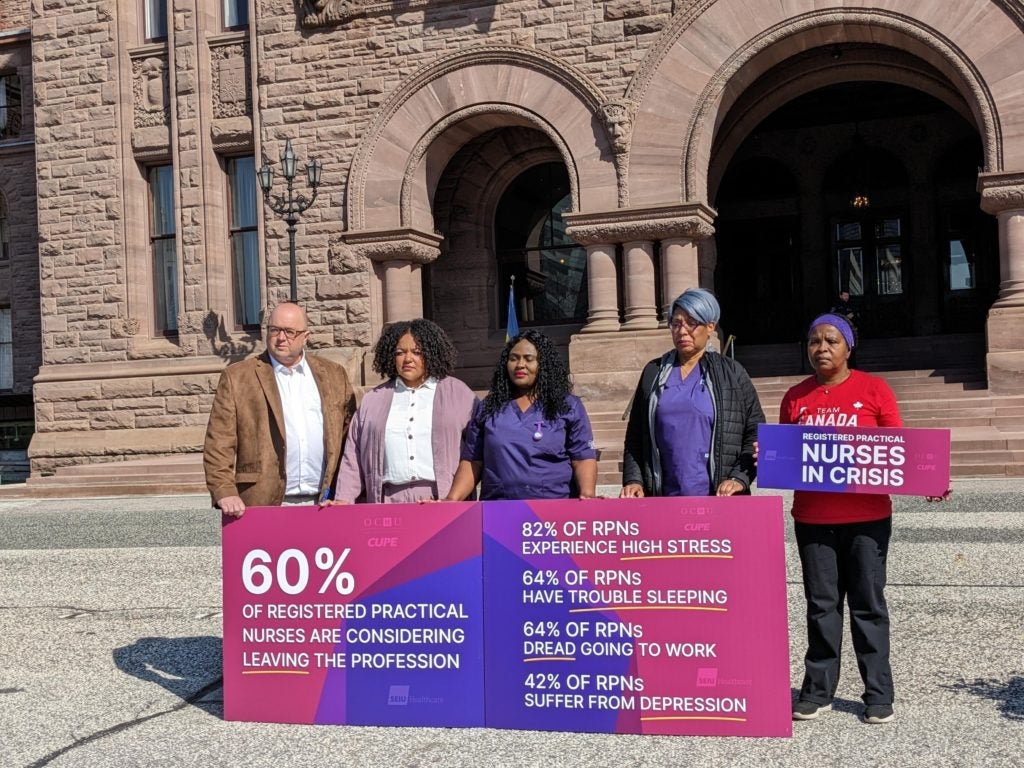
More than 60% of registered practical nurses are being driven out of health care by understaffing and low pay, putting patient care at risk

With a recent poll showing that Ontario is at-risk of losing more than 60% of its registered practical nurses (RPNs) workforce, RPNs made an emotional appeal to the Doug Ford government to step up investments in wages and improved working conditions to stop thousands more from leaving nursing.

The poll, conducted by Nanos Research of behalf of the Canadian Union of Public Employees (CUPE) and SEIU Healthcare, identifies short staffing, physically and mentally draining workloads and supressed wages as the main causes of the RPN exodus.

638 of the 1029 RPN poll respondents said they considering leaving their profession. If those findings are extrapolated to the 59,000 RPNs the College of Nurses says are registered in Ontario, more than 36,500 – nearly two thirds of the RPN workforce – are considering leaving.

“That’s a staggering number of RPNs potentially poised to go. The provincial government should be moving at record speed to stop that from happening, but to most RPNs, they appear indifferent,” Dave Verch an RPN and first vice-president of CUPE’s Ontario Council of Hospital Unions (OCHU/CUPE).

Among Canadian provinces, Ontario, with its high rent and housing costs, is particularly vulnerable to RPN retention and attraction problems, says Verch. Yet unlike B.C. which has brought in a basket of measures from improved nurse-to-patient ratios, higher wages, and $100 million fund to support nurse well-being, the Ontario “government has instead offered RPNs a substantial wage cut and unprecedented understaffing and workload.“

A majority of RPNs say they work short with 53% reporting they work short-staffed almost everyday and 74% saying they work short 3 or 4 times a week. The result of working short in their increasingly expanded role providing patient care in our hospitals is that:

  • 82 % of them experience high stress
  • 64% have trouble sleeping
  • 64% dread going to work
  • 42% suffer depression

“Stress is endemic. Trouble sleeping is pervasive. Dread is everywhere and pride is nowhere. And at 42 per cent, depression among registered practical nurses is almost more common than not. We’re here to tell the Ford government, the Ontario Hospital Association, big nursing home chains, and frankly the public, that healthcare services will get worse and wait times will grow longer if we do not address the working conditions for registered practical nurses and all nurses.” says Jackie Walker, SEIU Healthcare Nursing Division President.

Over the last three years, RPNs are seeing an increasing role in emergency departments (nearly 18% report this) and in acute/intensive or critical care (nearly 13%). Over four in ten also say they cover registered nurses’ shifts on their unit every day or almost every day.

Just days away from Nursing Week (May 8-14), two RPNs Pam Parks and Abiemwense Osawe called on the Ford government for an immediate solution that includes safe staffing, fair wages and to not appeal the court decision deeming their wage cap (Bill 124) unconstitutional.

Get involved with your union

CUPE 5492 is currently looking  for a new recording secretary, membership officer, trustees, and for our by-law committee.

To find out more about how you can be involved in our local union or if you are interested in sitting on a union committee, contact us at:

cupelocal5492@gmail.com